Crate training is one of the most valuable skills you can teach an American Bully puppy. When introduced correctly, a crate provides a safe, comfortable environment where your dog can relax, sleep, develop independence, and establish healthy daily routines.
Whether you own a Micro Bully, Pocket Bully, Standard American Bully, Classic Bully, or XL Bully, the principles of successful crate training remain the same.
American Bullies are affectionate, people-oriented dogs that often form strong bonds with their families. Teaching your puppy to feel comfortable spending short periods alone can help encourage confidence and independence while supporting house training.
The goal is not to confine your American Bully for extended periods. It is to create a positive personal space your dog willingly enters and enjoys.
This American Bully crate training guide explains everything from choosing the correct crate to establishing a daily routine and overcoming common training challenges.
Table of Contents
- What Is Crate Training?
- Benefits of Crate Training an American Bully
- Choosing the Right Crate
- American Bully Crate Size Guide
- Preparing Your Puppy’s Crate
- Step-by-Step Crate Training
- Daily Crate Training Schedule
- Crate Training at Night
- Combining Crate Training and Potty Training
- How Long Can an American Bully Stay in a Crate?
- Common Crate Training Mistakes
- Managing Crying and Separation Distress
- Transitioning Away From the Crate
- Frequently Asked Questions
What Is Crate Training?
Crate training is the process of teaching a dog to associate an appropriately sized enclosure with safety, comfort, and relaxation.
Rather than viewing the crate as punishment, your American Bully should gradually learn that it is a familiar place where positive experiences happen.
A properly introduced crate can become your dog’s:
- Personal sleeping area
- Quiet retreat
- Safe resting environment
- Temporary space during supervised household routines
- Familiar environment during travel
- Tool for developing independence
Crate training should always rely on positive reinforcement, patience, and gradual progression.
Benefits of Crate Training an American Bully
1. Supports Potty Training
Many puppies naturally prefer to avoid soiling their sleeping area. An appropriately sized crate, combined with frequent outdoor bathroom breaks, can help establish predictable potty habits.
However, puppies should never be expected to hold their bladder beyond their physical capabilities.
2. Helps Prevent Destructive Behavior
American Bully puppies explore their surroundings through chewing, especially during teething.
A crate can provide a temporary safe environment when direct supervision is unavailable, helping reduce exposure to electrical cords, furniture, household chemicals, and other hazards.
3. Encourages Independence
American Bullies often enjoy being close to their owners. Gradually introducing short periods of independent rest can help puppies become more comfortable when their owners are not immediately beside them.
Crate training alone, however, is not a treatment for separation anxiety.
4. Establishes Healthy Sleeping Habits
A consistent crate routine helps puppies recognize when it is time to rest.
Adequate sleep is essential for physical development, learning, emotional regulation, and overall puppy wellness.
5. Improves Travel Preparedness
Dogs comfortable with appropriate enclosures may adapt more easily to certain travel situations, veterinary visits, and temporary boarding arrangements.
For vehicle travel, use a properly secured, crash-tested travel crate or suitable vehicle restraint rather than assuming an ordinary household crate provides crash protection.
6. Provides a Personal Safe Space
A crate can give your American Bully somewhere to retreat when the household becomes busy, visitors arrive, or your dog simply wants uninterrupted rest.
Children and visitors should respect this space.
Choosing the Right Crate for Your American Bully
American Bullies have distinctive physical characteristics, including broad chests, muscular shoulders, wide heads, and compact or powerful frames.
These characteristics make proper crate sizing particularly important.
Your dog should be able to:
- Stand naturally without lowering its head
- Turn around comfortably
- Lie down in a natural sleeping position
- Stretch out comfortably
- Enter and exit without difficulty
Never select a crate based solely on your American Bully’s height or weight classification.
Wire Dog Crates
Wire crates are popular for home training because they provide ventilation, visibility, and convenient access.
Advantages:
- Excellent airflow
- Easy cleaning
- Adjustable dividers on many models
- Foldable designs
- Multiple door options
Wire crates are often a practical starting point for American Bully puppies.
Plastic Dog Crates
Plastic crates offer a more enclosed environment that some dogs find comfortable.
Advantages:
- Greater privacy
- Durable construction
- Easy-to-clean surfaces
- Certain models suitable for approved transportation arrangements
Always ensure sufficient ventilation, especially for American Bullies with shorter muzzles.
Heavy-Duty Dog Crates
Heavy-duty crates may be appropriate for larger, physically powerful adult dogs that are already comfortable with confinement.
However, a stronger crate is not a solution for panic, separation anxiety, or repeated escape attempts. Dogs experiencing severe confinement distress may injure themselves attempting to escape.
Furniture-Style Dog Crates
Furniture-style crates combine household décor with a designated resting area.
They are generally better suited to reliably crate-trained adult dogs than puppies going through destructive chewing stages.
American Bully Crate Size Guide
The following chart provides general starting points when shopping for a crate.
| American Bully Type | Suggested Crate Length |
|---|---|
| Micro Bully | 24–30 inches |
| Pocket Bully | 30–36 inches |
| Standard American Bully | 36–42 inches |
| Classic American Bully | 36–42 inches |
| XL Bully | 42–48 inches or larger |
These are approximate shopping guidelines, not breed-specific sizing standards.
Individual dogs may require larger or wider crates depending on their body proportions.
How to Measure Your American Bully
- Measure from the tip of the nose to the base of the tail while your dog is standing.
- Measure from the floor to the highest point of the head or ears while standing or sitting naturally.
- Add approximately two to four inches to these measurements as a starting point.
- Check the crate’s internal width and confirm your dog can turn around and lie down comfortably.
- Follow the manufacturer’s sizing recommendations.
For growing puppies, consider purchasing an adult-sized crate with an adjustable divider.
Recommended Crate Training Supplies
Having the correct equipment makes crate training easier and more comfortable for both puppies and owners.
Consider preparing the following supplies:
- Appropriately sized dog crate
- Adjustable crate divider
- Washable crate mat
- Puppy-safe chew toys
- Food and water bowls
- Positive reinforcement training treats
- Enzymatic accident cleaner
- Puppy exercise pen
- Securely attached water bowl when appropriate
Choose bedding and toys according to your puppy’s chewing habits. Remove items that may become choking or ingestion hazards.
For more information about dog crates, puppy training equipment, bedding, and everyday ownership essentials, explore All Breeds Dog Store.
Preparing Your American Bully Puppy’s Crate
The location and setup of your puppy’s crate can influence how quickly your dog becomes comfortable using it.
Choose a Comfortable Location
Place the crate in a quiet but socially connected area of your home.
Good locations may include:
- Living room
- Family room
- Bedroom
- Quiet corner of a frequently occupied room
Avoid placing the crate in direct sunlight, poorly ventilated rooms, or areas exposed to extreme temperatures.
American Bullies, particularly dogs with shorter muzzles, may be more vulnerable to overheating and breathing difficulties.
Create Positive Associations
Place treats or suitable toys inside the crate and allow your puppy to investigate independently.
Initially, leave the crate door open.
Avoid pushing your puppy inside or closing the door before your puppy feels comfortable.
Make Safety a Priority
Remove collars, harnesses, and leashes before crating to reduce the risk of entanglement.
Ensure your puppy has appropriate ventilation, comfortable temperatures, and access to water according to its needs and the duration of confinement.
How to Crate Train an American Bully Puppy: Step-by-Step
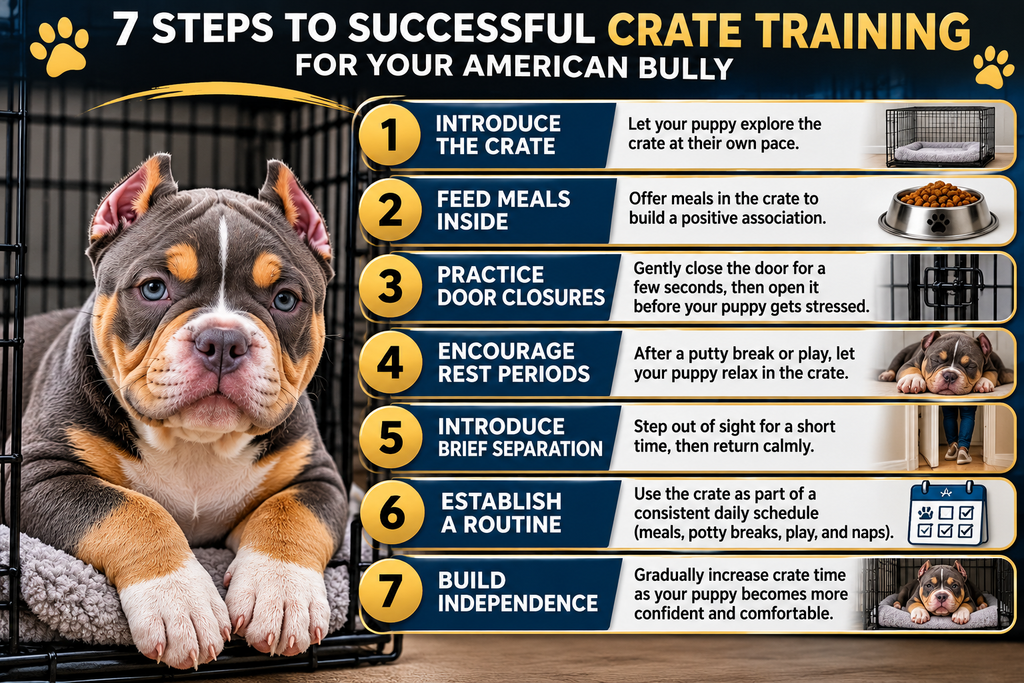
Step 1: Introduce the Crate
Begin by allowing your puppy to explore the crate voluntarily.
Place treats near the entrance and gradually move them farther inside.
Reward your puppy whenever it enters willingly.
Do not close the door immediately.
Step 2: Feed Meals Inside the Crate
Once your puppy is comfortable entering, begin offering meals inside the crate.
Initially, leave the door open while your puppy eats.
This helps establish a positive association between the crate and enjoyable experiences.
Step 3: Introduce Short Door Closures
When your puppy enters confidently, gently close the door for a few seconds while remaining nearby.
Open the door before your puppy becomes distressed.
Gradually increase the duration as your puppy remains comfortable.
Step 4: Practice Short Rest Periods
After a bathroom break, gentle play session, or training activity, encourage your puppy to rest inside the crate.
Stay nearby during the early stages.
Reward calm behavior and gradually extend resting periods.
Step 5: Introduce Brief Separation
Once your puppy is comfortable resting with the door closed, briefly move out of sight.
Begin with only a few seconds and return calmly.
Increase the duration gradually rather than immediately leaving your puppy alone for long periods.
Step 6: Establish a Consistent Routine
Use the crate as part of your puppy’s daily schedule.
Predictable feeding times, bathroom breaks, play sessions, and naps help your puppy understand what to expect throughout the day.
Step 7: Encourage Independent Crate Use
As training progresses, your American Bully may begin entering the crate voluntarily when tired.
Continue rewarding this behavior and allow the crate to remain a positive resting environment.
Seven-Day American Bully Crate Training Plan
Every puppy learns at a different pace. The following schedule is an example rather than a mandatory timeline.
| Day | Training Goal | Recommended Activity |
|---|---|---|
| Day 1 | Crate introduction | Open-door exploration and treats |
| Day 2 | Positive association | Feed meals inside the crate |
| Day 3 | Door introduction | Practice brief door closures |
| Day 4 | Calm resting | Encourage short, supervised naps |
| Day 5 | Independence | Briefly move out of sight |
| Day 6 | Routine development | Combine crate rest with potty breaks |
| Day 7 | Confidence building | Repeat successful exercises and gradually progress |
If your puppy shows distress, return to an earlier stage.
Successful crate training may take several days, weeks, or longer depending on age, temperament, and previous experiences.
Sample American Bully Puppy Crate Training Schedule
Consistency is especially important during the first few weeks at home.
The following is an example daily routine for a young American Bully puppy.
| Time | Activity |
|---|---|
| 6:30 AM | Wake up and outdoor potty break |
| 6:45 AM | Breakfast |
| 7:00 AM | Potty break |
| 7:15 AM | Gentle play and training |
| 8:00 AM | Crate nap |
| 9:00 AM | Potty break and supervised activity |
| 10:00 AM | Rest period |
| 11:30 AM | Potty break and lunch |
| 12:00 PM | Potty break and supervised play |
| 1:00 PM | Crate nap |
| 2:00 PM | Potty break and socialization |
| 3:00 PM | Rest and supervised activity |
| 5:00 PM | Dinner and potty break |
| 6:00 PM | Family interaction and training |
| 8:00 PM | Quiet activity and potty break |
| 10:00 PM | Final potty break and bedtime |
Additional bathroom breaks should be provided whenever your puppy wakes up, finishes eating, drinks heavily, plays, or shows signs of needing to eliminate.
Very young puppies may also need overnight bathroom breaks.
Adjust feeding frequency, rest periods, and activity levels according to your puppy’s age and veterinarian’s recommendations.
Crate Training an American Bully Puppy at Night
The first few nights in a new home can be challenging for puppies.
Your American Bully may have recently separated from its mother, littermates, and familiar surroundings.
Some uncertainty and vocalization are understandable.
To help your puppy settle:
- Position the crate near your bed initially.
- Provide a bathroom break immediately before bedtime.
- Keep nighttime interactions calm and brief.
- Maintain a comfortable room temperature.
- Offer reassurance without turning bedtime into playtime.
- Provide overnight potty breaks when needed.
As your puppy becomes more confident, you can gradually move the crate to its permanent sleeping location.
Avoid leaving a frightened puppy to cry for extended periods.
Combining Crate Training With Potty Training
Crate training and potty training work best when introduced together.
A predictable bathroom routine helps your American Bully understand where and when elimination should occur.
Take your puppy outside:
- Immediately after waking
- After meals
- After drinking
- After play sessions
- Before entering the crate
- Immediately after leaving the crate
- Before bedtime
Reward successful outdoor bathroom breaks immediately with praise or a small treat.
If an accident occurs, clean the area with an enzymatic cleaner and adjust your schedule.
Never punish your puppy for having an accident.
Accidents often indicate that the puppy needed a more frequent bathroom break, had too much unsupervised freedom, or has not yet developed reliable bladder control.
How Long Can an American Bully Stay in a Crate?
The appropriate amount of crate time depends on age, health, training progress, bladder control, and emotional comfort.
The following guidelines are conservative starting points for daytime confinement after successful crate introduction.
| Puppy Age | Approximate Daytime Crate Interval |
|---|---|
| 8–10 weeks | 30–60 minutes |
| 10–12 weeks | 1–2 hours |
| 3–4 months | 2–3 hours |
| 4–6 months | 3–4 hours |
| 6 months and older | Approximately 3–4 hours between breaks when possible |
| Adult American Bully | Approximately 4 hours or less at a time as a regular routine |
These intervals are not guaranteed bladder-holding limits. Some dogs require considerably more frequent breaks.
Overnight sleeping patterns may differ from daytime confinement.
American Bullies should not spend most of their waking hours inside a crate. They require exercise, companionship, enrichment, training, bathroom opportunities, and freedom of movement.
Owners who work long hours should consider a puppy-proofed room, exercise pen, dog walker, or trusted caregiver.
Common American Bully Crate Training Mistakes
Using the Crate as Punishment
Sending your dog to the crate as punishment can create negative associations.
The crate should remain a safe and comfortable environment.
Progressing Too Quickly
Closing the door for extended periods before your puppy is comfortable can create fear and resistance.
Build confidence gradually.
Choosing the Wrong Crate Size
A crate that is too small can restrict comfortable movement.
A poorly adjusted oversized crate may also make early potty training more difficult.
Crating Without Bathroom Breaks
Always provide appropriate bathroom opportunities before and after confinement.
Ignoring Exercise and Mental Stimulation
A crate cannot replace physical activity, social interaction, or enrichment.
American Bullies benefit from age-appropriate exercise, gentle training, and mentally stimulating activities.
Ignoring Signs of Overheating
Poor ventilation and excessive temperatures can create serious health risks, particularly for dogs with shortened muzzles.
Leaving Unsafe Items Inside
Avoid unattended access to toys, bedding, or accessories that your dog may destroy and swallow.
Expecting Immediate Results
Crate training is a learning process.
Patience and consistency are more effective than forcing rapid progress.
What to Do if Your American Bully Cries in the Crate
Puppies may vocalize for several reasons, including:
- Needing a bathroom break
- Hunger or thirst
- Unfamiliar surroundings
- Physical discomfort
- Excessive energy
- Fear of confinement
- Separation-related distress
First, determine whether your puppy has an unmet physical or emotional need.
Brief, mild vocalization may occur during adjustment, but persistent or escalating distress should not be ignored.
Signs of serious distress may include:
- Excessive panting
- Heavy drooling
- Frantic barking
- Repeated escape attempts
- Biting or scratching the crate
- Inability to settle
- Self-injury
If these behaviors occur, safely end the confinement session and reconsider your training approach.
Consult your veterinarian or a qualified reward-based canine behavior professional if problems persist.
A stronger crate or longer confinement is not the appropriate solution for separation anxiety.
Crate Training Micro and Pocket Bullies
Micro and Pocket Bullies may have shorter frames, but their broad shoulders, muscular bodies, and wide heads still require adequate crate space.
Pay particular attention to:
- Internal crate width
- Comfortable sleeping positions
- Ventilation
- Temperature control
- Easy entry and exit
- Unrestricted breathing
Dogs with exaggerated physical features may require additional accommodations.
Learn more about Micro Bully structure, care, and ownership at The Micro Bully Breed.
Crate Training an XL Bully
XL Bullies require appropriately sized equipment capable of accommodating their larger frames.
Owners should prioritize:
- Adequate standing height
- Sufficient internal width
- Comfortable resting space
- Secure construction
- Proper ventilation
- Positive reinforcement training
Begin crate training early when possible, but remember that adult dogs can also learn to use a crate comfortably.
The dog’s emotional response to confinement is just as important as the strength and size of the equipment.
When Can You Stop Crating Your American Bully?
As your American Bully matures, you may gradually introduce greater household freedom.
Signs that your dog may be ready include:
- Reliable potty training
- Reduced destructive chewing
- Ability to settle independently
- Comfortable behavior when left alone
- Reliable household manners
- No unsafe exploration habits
Begin with short periods in a puppy-proofed room and gradually expand access as your dog demonstrates reliable behavior.
Many adult American Bullies continue using an open crate voluntarily throughout their lives.
There is no requirement to remove the crate if your dog enjoys using it as a resting area.
Preparing for Your New American Bully Puppy
Successful crate training begins before your puppy arrives.
Preparing your home, purchasing appropriate supplies, and establishing a consistent routine can make the transition easier for everyone.
If you are still searching for an American Bully puppy, visit Bully Puppy Market to explore the marketplace, learn about participating breeders, and search available puppy listings.
Ask your breeder whether your puppy has already been introduced to crates, household routines, sleeping areas, and early potty training.
Understanding your puppy’s previous experiences can help you create a smoother transition into your home.
Frequently Asked Questions
Are American Bullies easy to crate train?
Many American Bullies respond well to consistent, reward-based training. Individual temperament, age, previous experiences, and training methods influence how quickly a dog becomes comfortable.
What age should I start crate training my American Bully?
Gentle crate introduction can begin when a puppy arrives home, commonly at eight weeks of age or older. Some responsible breeders introduce positive crate experiences before puppies leave for their new homes.
Should I cover my American Bully’s crate?
A partial crate cover may help some dogs relax, but it must not restrict ventilation or increase the temperature inside the crate. Avoid covers your puppy can pull through the bars and chew.
Should I put a puppy pad inside the crate?
Generally, puppy pads are better placed in a separate designated bathroom area rather than the sleeping crate. If your puppy cannot receive frequent outdoor breaks, an exercise pen with separate sleeping and bathroom areas may be more appropriate.
Can my American Bully sleep in a crate every night?
Yes, provided the crate is appropriately sized, comfortable, well ventilated, and positively associated with sleep. Young puppies may require overnight bathroom breaks.
Should I leave water inside the crate?
Dogs should have appropriate access to fresh water. For longer rest periods, consider a securely attached, spill-resistant water bowl. Never restrict necessary water intake simply to prevent accidents.
Can an older American Bully be crate trained?
Yes. Adult American Bullies can learn to enjoy a crate through gradual introduction and positive reinforcement.
Does crate training prevent separation anxiety?
Crate training can support independence in some dogs, but it does not guarantee prevention or treatment of separation anxiety. Dogs experiencing separation-related distress may require a specialized behavior plan.
Final Thoughts: Building Confidence Through Crate Training
American Bully crate training is about much more than teaching your dog to remain inside an enclosure.
It is about building confidence, encouraging healthy routines, supporting potty training, and providing a comfortable environment where your dog feels secure.
By choosing the correct crate, introducing it gradually, rewarding positive behavior, and respecting your puppy’s physical and emotional needs, you can establish habits that benefit your American Bully throughout its life.
Remember the five foundations of successful crate training:
Comfort • Safety • Patience • Consistency • Positive Reinforcement
A properly introduced crate should become a place your American Bully chooses to enter—not a place your dog fears.
Continue Learning: American Bully Puppy Care & Training
Continue building your knowledge with our American Bully puppy care, behavior, and training resources.
Explore Our Educational Resources
- American Bully Breed — Breed education, puppy care, training, and responsible ownership.
- The Micro Bully Breed — Micro Bully care, structure, health, and ownership.
- The Complete Dog Guide — Dog training, nutrition, health, and puppy development.
- Modern Dog Living — Healthy routines, enrichment, and everyday dog wellness.
- All Breeds Dog Store — Dog crates, training supplies, puppy essentials, and product buying guides.
- Bully Puppy Market — Explore American Bully puppy listings and participating breeders nationwide.
American Bully Breed — Education for Better Ownership.